
Something to Consider When a Loved One Has Cancer
Posted November 16, 2025.
Est. Reading Time: 4 minutes.
About a year and a half has passed since my last post. There’s been big changes in my life: Moving to Bakersfield from Los Angeles is one of them; another one has to do with something I’ll share here.
There’s a moment that often comes back to me from late spring of last year. In that time, I’m still living in Los Angeles and returning home from a weekend out. Our house is quiet these days. There’s five bedrooms but only three us. I’m in the dining room, and the lights that I like are on. Everything looks dark outside our windows. Everything inside looks painted by candlelight. My mom is walking into the room to greet me; hearing her voice makes me happy.
But seeing her walk into the room is different this evening. We’ve known about my mom diminishing for some time. Single hair strands sticking to sweaters and furniture. Her stomach wanting less and less by the day. And tonight, her eyes are hiding. They’re too busy to greet me. They’re looking and looking at the dining room table. Her head is tilted down as if heavy from this search. Then the lights reveal parts of her scalp. My eyes are doing the same thing now. Looking and looking. Bright patches. A long smile spread from cheek to cheek. She holds it for so long as she points to the top of her head. I feel we both have lost something. I want to hold her.
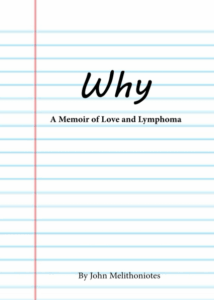
After my mother was diagnosed, John Melithoniotes’ memoir was the first book I read. Why: A Memoir of Love and Lymphoma is the story about John and his wife Marilyn. Here’s one way their story helped me.
Distance and Space
Marilyn was not Greek. She was not Greek Orthodox. I felt a responsibility to my parents to maintain our family, our Greekness, and to repay them for all they had lost when they left Greece.
There is only one beginning in Melithoniotes’ memoir. It’s when he meets Marilyn in September 1977. “For the first time in my life, a woman desired me. And my desire for her grew till I felt it was almost like an addiction,” he said. These first moments of togetherness also began with everything that kept them apart. “Over a short span of about five weeks, my need for her grew every day. But I simultaneously felt the need to escape from her and our relationship.”
Their greatest challenge, the greatest distance in their love, begins with Marilyn’s diagnosis with non Hodgkin’s lymphoma. “For thirty-nine years, Marilyn and I talked easily and continuously to each other. Suddenly we became quiet,” he writes. But love is never in question. It’s there as John holds her up each night so she can reach the bathroom. It’s seen in their days of hospital visits. “We had vaguely spoken to each other at various times in our lives about the eventual death of the other…Suddenly death was not so far,” he said.
They knew that true love would face suffering. So, John was always near Marilyn. He didn’t want to lose her. Better the course of love overcoming suffering than to accept it as the ending. “I’ve settle on the idea that I hoped for another fifteen years of good life for Marilyn, and I keep thinking of that number over and over,” he said.
But John began losing Marilyn after her diagnosis. With cancer, you are forced to lose piece by piece. This is what McGahem meant when he said time is for the living: “the church in which they had married proclaimed them one flesh, but no, no no… People rotted apart.” Life wasn’t moving faster for her. Life seemed to stop moving at all. Unsatisfied with hours, death consumed, devouring a lifetime. Susan Gubar referred to this experience of surviving the present, “when the substances of the everyday is drained of reality.” Cancer made every moment tragic. As if alive but no longer part of this world.
I didn’t know how much of the growing quiet between us was caused by her mouth sores, and how much by her struggle with her thoughts.
We can lose someone by reaching as far as one can into them. John perhaps felt like this at times: “Had I become so heartless? So unable to understand what she was suffering… I was pushing her to do something she didn’t want to do, or couldn’t do. I have become a kind of tormentor.” Yet when distance becomes too great from one person to another, honesty as well as empathy are blinded; this absence of being in a place to give and receive each other’s experience is how closeness disappears. We become trapped by our words, our silence, our honesty, our lies; we are unable to receive these in return. There is no space for them.
Two different things, however, are true at the same time for John and Marilyn. His words seemed to no longer reach her—but love is never in question. We see their togetherness and separateness simultaneously; the space that held them together, the distance between them.
The story is about John’s and Marilyn’s love. Gubar’s reference the idea of a “double frame of mind” that people with terminal or near-death conditions experience: “Laboring to survive in the present, we simultaneously image our future demise.” This is a shared experience for John and Marilyn. He faced the possibility of death with her. His conclusion of fifteen more years is an example. It’s his reaction to the possibility of being forever apart from her. Because death is the inability to ever give and receive love from the departed person. Loss makes loving a painful memory, a lonely experience. But his memoir is how Marilyn becomes a part of him. It’s a glimpse into how togetherness is rediscovered; for all the suffering in its course, distance is never too great for the yearns of love.